
Why serial experiments lain Feels Contemporary Again
Its renewed place in Japanese internet culture is not just Y2K nostalgia. lain now speaks directly to fragmented identity, AI, and the loneliness of a permanently connected world.
Over the past few years, serial experiments lain has begun to attract unusually strong attention again in parts of Japanese internet and subculture circles.
The series has long been a byword for cult anime: famous enough to be widely recognized, yet distinctive, bleak, and philosophically dense enough to keep many viewers at a distance. For a long time, its most visibly intense fandom often seemed to be overseas rather than in Japan. From a Japanese perspective, there was sometimes a sense of encountering the work again through the enthusiasm it had accumulated abroad.
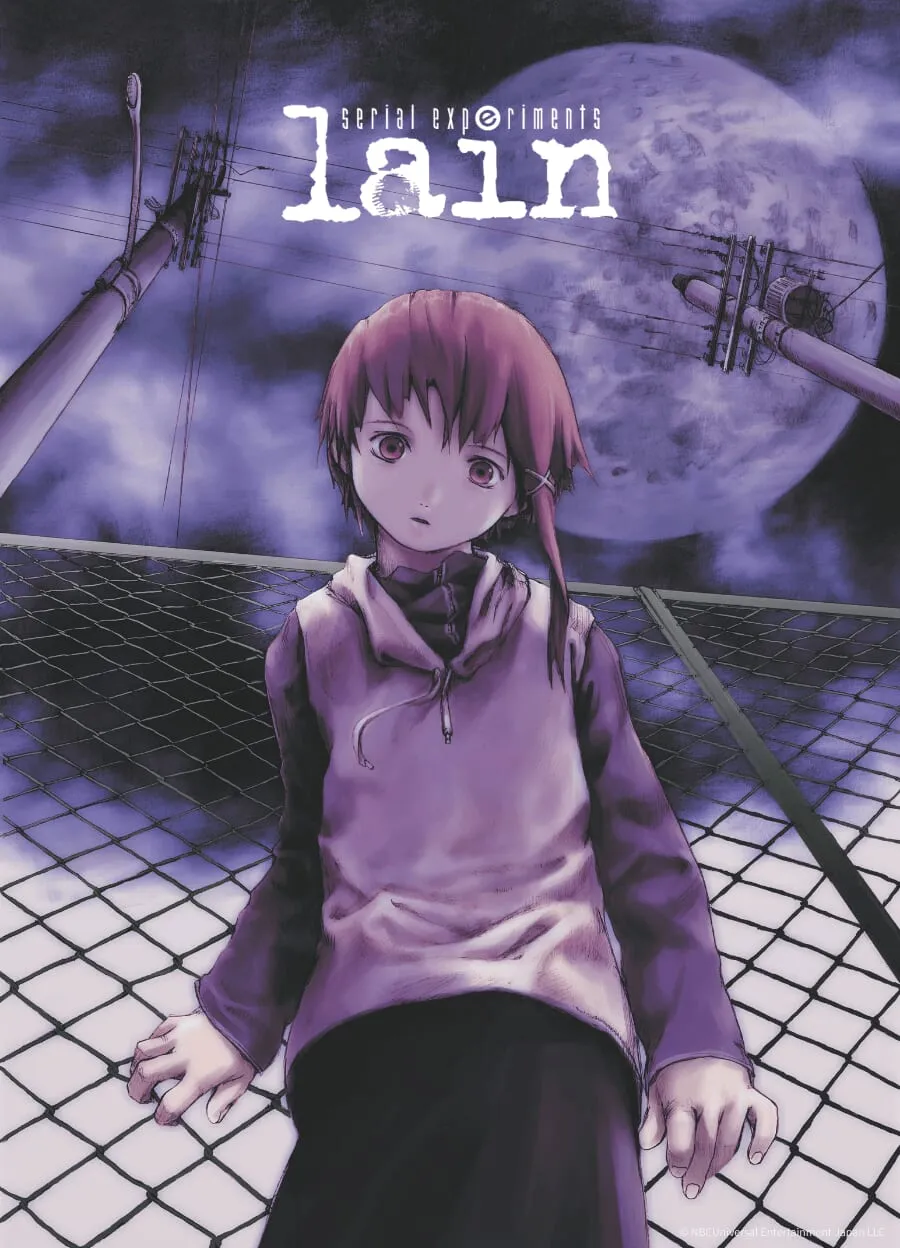
Image source: EYESCREAM
The networked self is no longer abstract
What makes the current revival interesting is that it cannot be explained simply by the return of late-1990s cyber aesthetics. The problems lain depicts have become more immediate in the information society we now live in.
The world of lain is one in which greater connection does not necessarily produce a stronger sense of self. Instead, the boundaries of the individual become less stable. There is the self one experiences privately, the self recognized by other people, and the self that circulates through the network. As those versions split apart, the question of which one is the real “me” becomes harder to answer. Information connects people, but it can also erode selfhood and deepen isolation.
With social media and generative AI now part of everyday life, that anxiety feels far less abstract than it did in 1998. Records, images, opinions, and evaluations about us accumulate online, while versions of “us” continue to exist outside our direct control. AI can now reconstruct voices, writing styles, images, and even the appearance of personality. The boundary between a person and information about that person is becoming increasingly difficult to draw.
In that sense, lain does not feel important today because it accurately predicted a checklist of future technologies. It feels important because reality has moved closer to the psychological conditions the series was interested in.
When AI fits the fiction
That also makes the official stance around lain especially interesting. The official side of the project has published public-facing guidelines for the use of its content, and projects such as AI lain have treated the character as something that can exist interactively on the network.
Generative AI often sits uneasily beside established ideas of authorship and creative ownership. With lain, however, the friction is unusually complicated. The work itself is concerned with identity being copied into information, distributed across a network, and separated from any simple distinction between an original person and a version of that person. Reconstructing Iwakura Lain through AI can therefore look less like a violation of the fiction’s logic than an uncanny continuation of it.
That does not settle the broader arguments around AI and art. It simply means that, in this particular case, the technology collides with a work whose central questions were already about replication, mediation, identity, and the instability of the self.
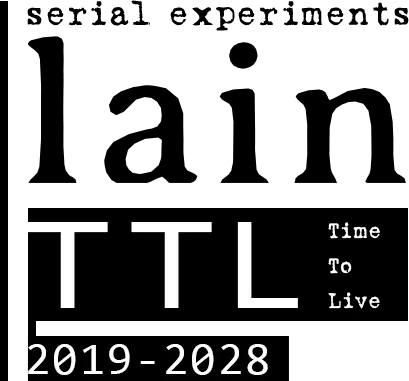
Image source: NBCUniversal Entertainment Japan — serial experiments lain
A note on the name “Lain”
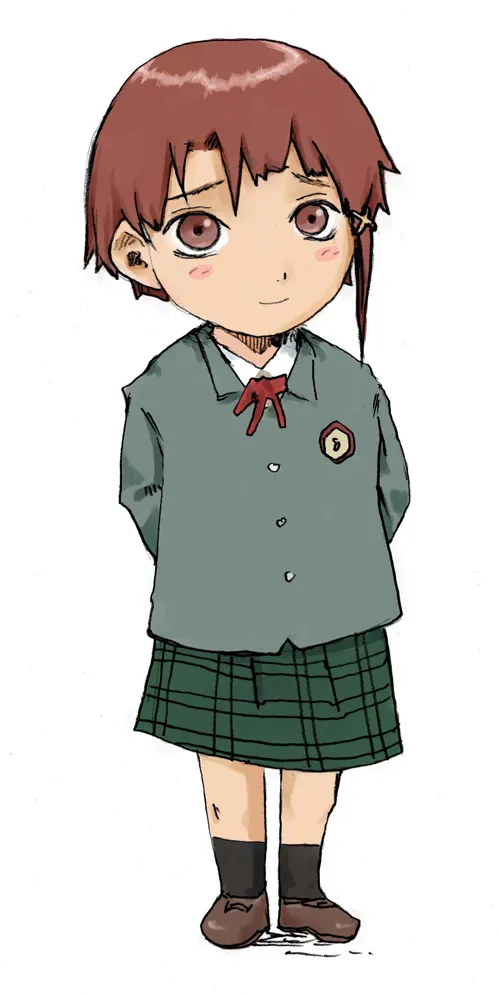
Image source: NBCUniversal Entertainment Japan — serial experiments lain
Kawaii around the darkness
There is another reason the series has remained so easy to carry forward: Iwakura Lain herself.
The world around her is deeply bleak. The series is filled with the breakdown of identity, estrangement from other people, suicide, rumor, surveillance, and the loss of a stable sense of reality. Its prevailing emotional atmosphere is cold, enclosed, and lonely. Yet at the center of all of this is a small, quiet, awkward girl who is also unmistakably kawaii.
That contrast matters. lain wraps heavy, abstract ideas about isolation and the erosion of selfhood around a character people can feel affection for. The darkness is not removed, but it is given a human scale.
If the same ideas had been presented only as sterile philosophical science fiction, the work might not have remained so intimate to internet culture for so long. But if Lain had been merely a cute character, she would not have accumulated the same symbolic weight. The two sides strengthen each other.
Because “cute Lain” and a nearly hopeless networked world coexist, the bleakness becomes easier to approach without becoming harmless. The character gives viewers a point of emotional attachment inside a work that is otherwise determined to destabilize them.
More than Y2K nostalgia
This is why the current interest in lain feels larger than a revival of Y2K visual language. We live in a period in which people are connected more continuously than ever, yet many still experience that connection as loneliness. At the same time, the question of who we are has become harder to separate from profiles, archives, recommendations, reputations, and machine-generated representations.
Iwakura Lain has become a particularly effective symbol for that condition: dark and unsettling, but also familiar and lovable. She gives a face to the contradiction of a network that promises connection while making the self feel less certain.
There is also a distinctive strand of Japanese internet aesthetics in which kawaii and yami — cuteness and psychological darkness — are allowed to sit beside each other without one automatically cancelling out the other. lain clearly belongs near that tradition, although the subject deserves a separate discussion.
Would it be too glib to say that lain, perhaps without intending to, turned the loneliness of the networked age itself into something that could circulate as culture? Perhaps. But I do not think turning psychological pain into recognizable symbols necessarily makes it trivial. In Japanese culture, at least, there can also be a seriousness in giving that pain a form people can share, recognize, and live with.
—



Comments
Name and email are optional. Comments and names are public and may be moderated. Email addresses are not published. Privacy Policy.