
Why Do So Many Japanese Women’s Names End in “-ko”?
From imperial princesses to Chainsmoker Cat, the history of Japan’s most recognizable feminine name ending.
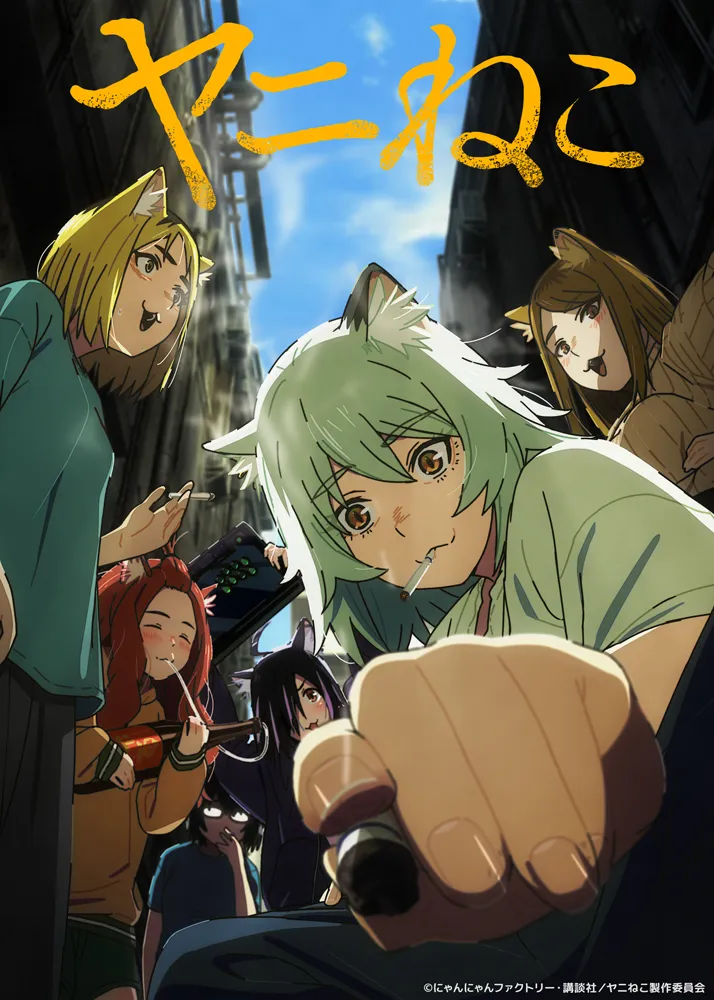
Official Yani Neko anime key visual, released April 3, 2026.
Image and announcement: official anime website. Rights: ©にゃんにゃんファクトリー・講談社/ヤニねこ製作委員会.
The cat-eared troublemakers of Yani Neko (Chainsmoker Cat) have names that sound oddly ordinary to Japanese ears. The chain-smoking heroine is Yaniko. Her hard-drinking friend is Aruko. Another is Hameko. Their names are built around jokes, yet the ending that makes them sound like women’s names—ko (子)—has a history reaching back more than a thousand years.
The joke in the cats’ names
The TV anime, which premiered in Japan in July 2026, is adapted from the manga by Nyan Nyan Factory. According to its official character profiles, the heroine’s full name is Satō Yaniko (佐藤ヤニ子): yani is the Japanese word for tobacco tar or nicotine residue, while 子 (ko) gives the result a familiar feminine-name ending. Sakai Aruko (酒井アル子), a heavy drinker, similarly plays on the beginning of arukōru, the Japanese rendering of “alcohol.”
The same pattern appears in Hameko (ハメ子) and Imoko (妹子, literally “younger sister” plus ko). Kaoruko (薫子), the Kansai-accented cat’s given name, is a more conventional example. Not every character’s name is a simple vice-plus-ko construction, but the recurring ending helps make the group’s absurd names instantly recognizable as feminine names.
This works as a joke precisely because “add ko” is such an established naming convention. The ending can make an almost arbitrary word resemble a woman’s first name.
A name ending with imperial roots
The character 子 means “child.” It was not originally reserved for female names: ancient male figures, including the diplomat Ono no Imoko (小野妹子), also bore it. The modern association with women developed later.
An important turning point came in the ninth century. Emperor Saga established naming conventions for his children, including names ending in 子 for imperial daughters. A historical explanation published by Mie Prefecture’s Saiku Historical Museum cites princesses such as Masako (正子), Yoshiko (芳子) and Shigeko (繁子). The court did not invent the use of 子 in names, but its prestige helped make this form an enduring convention among elite women.
The pattern also survives in the imperial family today. Princess Aiko (愛子) is a familiar modern example.
How “-ko” went from elite to ubiquitous
During Japan’s modernization in the Meiji period (1868–1912), names ending in ko spread beyond the nobility and became associated with respectable, formal feminine names. Name researcher Ivona Barešová, in her 2020 study Hiroko, Sachiko, Yōko: The Phenomenon of Female “-ko” Names in Modern Japan, traces this extraordinary rise and its eventual decline.
The scale of the fashion is visible in Meiji Yasuda Life’s historical baby-name rankings. From 1921 through 1956, every name in the annual top ten for girls ended in 子. Examples include Kazuko (和子), Sachiko (幸子), Keiko (恵子) and Yōko (洋子). The rankings measure the most popular names, not the percentage of all girls given a ko name; separate historical studies nevertheless confirm that the pattern was extraordinarily widespread.
The trend weakened in the postwar decades. By 1986, not one name in Meiji Yasuda’s top ten ended in 子. The popular names of 2025 likewise contain no ko name in the top ten. Contemporary names such as Riko, Hinako and Sakurako do still exist, however; “old-fashioned” does not mean extinct.
The appealing—but incorrect—kanji explanation
There is also a charming story about the written character 子. Split its modern shape into 一 (“one” or “beginning”) and 了 (“completion” or “ending”), the explanation goes, and the name expresses a wish for happiness from the beginning of life to the end.
That reading should not be confused with the character’s etymology. As J-CAST News reported in 2018, kanji scholar Hiroyuki Sasahara explained that the story does not fit ancient forms of the character. 子 originated as a pictograph depicting a child. The beginning-to-end interpretation is a later, popular form of folk etymology—an interesting example of how people attach new meanings to familiar names.
What international fans notice
The naming gag does not always translate automatically. On the Chainsmoker Cat subreddit, one viewer asked whether the other cats’ names “relate to their vices.” Other participants pointed out the jokes behind Yaku Neko and Aruko, showing how fans use translation discussions to unpack the series’ Japanese wordplay.
“do the other neko’s name relate to their vices?”
In a different Reddit discussion about Japanese naming, users debated whether ko sounds dated. Some mentioned modern examples such as Riko and Niko; when a commenter introduced herself as Mayuko, another replied:
“That’s so pretty it sounds like a princess name”
These are individual internet comments rather than evidence of a broader overseas consensus. Still, they capture two sides of the ending: its old-fashioned reputation and its continuing association with elegance.
From a traditional name to an everyday punchline
Japan also has a generic example name, Yamada Hanako (山田花子), roughly comparable to “Jane Smith” in an English-language sample form. Hanako itself follows the same name-building pattern: hana means “flower,” followed by 子. Even as baby-name fashion changes, the structure remains easy to recognize.
That is why Yaniko, Aruko and Hameko can work as immediate jokes. A form once associated with courtly naming and later with generations of ordinary Japanese women is still understood well enough that a manga can attach it to nicotine residue or alcohol—and the result still sounds like somebody’s name.
Sources
TV anime Yani Neko — key visual announcement (April 3, 2026)
TV anime Yani Neko — official character profiles
Saiku Historical Museum — the names of imperial princesses
Barešová (2020), The Phenomenon of Female “-ko” Names
Meiji Yasuda Life — historical ranking of girls’ names
Meiji Yasuda Life — 2025 name ranking
J-CAST News — investigation of the “一 + 了” explanation



Comments
Name and email are optional. Comments and names are public and may be moderated. Email addresses are not published. Privacy Policy.